When Do Babies Get More Than 4 Teeth
| Teeth | |
|---|---|
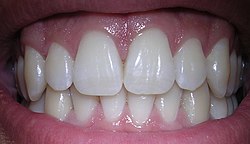 Prototype showing incisors and canine teeth, situated in gums higher up and beneath. | |
 Diagram of a homo molar showing its major constituents | |
| Details | |
| Identifiers | |
| Latin | dentes |
| TA98 | A05.i.03.001 |
| TA2 | 2818 |
| FMA | 75150 |
| Anatomical terminology [edit on Wikidata] | |
The human being teeth function to mechanically break downwardly items of food by cut and crushing them in preparation for swallowing and digesting. Humans have four types of teeth: incisors, canines, premolars, and molars, which each accept a specific part. The incisors cut the food, the canines tear the food and the molars and premolars crush the food. The roots of teeth are embedded in the maxilla (upper jaw) or the mandible (lower jaw) and are covered by gums. Teeth are made of multiple tissues of varying density and hardness.
Humans, like near other mammals, are diphyodont, meaning that they develop two sets of teeth. The first set, deciduous teeth, also chosen "main teeth", "baby teeth", or "milk teeth", commonly somewhen contains 20 teeth. Primary teeth typically start to appear ("erupt") around six months of age and this may exist distracting and/or painful for the babe. Even so, some babies are built-in with one or more visible teeth, known as neonatal teeth or "natal teeth".
Anatomy
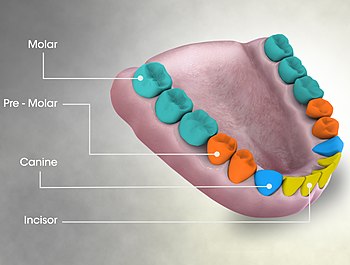
There are iv main types of teeth in humans, shown labelled hither.
Dental anatomy is a field of anatomy dedicated to the report of tooth structure. The evolution, advent, and classification of teeth fall within its field of study, though dental apoplexy, or contact between teeth, does not. Dental anatomy is also a taxonomic science as it is concerned with the naming of teeth and their structures. This information serves a practical purpose for dentists, enabling them to hands identify and describe teeth and structures during treatment.
The anatomic crown of a tooth is the area covered in enamel in a higher place the cementoenamel junction (CEJ) or "cervix" of the tooth.[1] [ii] Virtually of the crown is composed of dentin ("dentine" in British English) with the pulp bedchamber within.[three] The crown is within bone before eruption.[4] Subsequently eruption, information technology is almost always visible. The anatomic root is constitute below the CEJ and is covered with cementum. Every bit with the crown, dentin composes most of the root, which normally has lurid canals. Canines and most premolars, except for maxillary first premolars, usually have i root. Maxillary outset premolars and mandibular molars unremarkably take two roots. Maxillary molars usually have three roots. Additional roots are referred to as supernumerary roots.
Humans usually accept 20 primary (deciduous, "baby" or "milk") teeth and 32 permanent (adult) teeth. Teeth are classified as incisors, canines, premolars (also chosen bicuspids), and molars. Incisors are primarily used for cutting, canines are for tearing, and molars serve for grinding.
Near teeth have identifiable features that distinguish them from others. At that place are several different annotation systems to refer to a specific tooth. The three most common systems are the FDI World Dental Federation notation (ISO 3950), the Universal Numbering Organization, and the Palmer notation. The FDI system is used worldwide, the Universal only in the Usa, while the older Palmer notation however has some adherents only in the United Kingdom.
Primary teeth
Amid deciduous (master) teeth, ten are found in the maxilla (upper jaw) and ten in the mandible (lower jaw), for a full of 20. The dental formula for primary teeth in humans is 2.1.0.2 2.1.0.2 .
In the primary gear up of teeth, at that place are two types of incisors—centrals and laterals—and 2 types of molars—first and second. All primary teeth are commonly subsequently replaced with their permanent counterparts.
Permanent teeth

The Universal Numbering System for adult human teeth. The view is from a dental practitioner'due south perspective, meaning tooth 1 is the upper correct rear (third) molar.
Amidst permanent teeth, xvi are found in the maxilla and 16 in the mandible, for a full of 32. The dental formula is ii.one.2.3 2.1.two.3 . Permanent man teeth are numbered in a boustrophedonic sequence.
The maxillary teeth are the maxillary key incisors (teeth 8 and ix in the diagram), maxillary lateral incisors (vii and 10), maxillary canines (6 and 11), maxillary showtime premolars (5 and 12), maxillary 2nd premolars (4 and 13), maxillary first molars (iii and fourteen), maxillary 2nd molars (2 and xv), and maxillary 3rd molars (one and 16). The mandibular teeth are the mandibular primal incisors (24 and 25), mandibular lateral incisors (23 and 26), mandibular canines (22 and 27), mandibular first premolars (21 and 28), mandibular second premolars (twenty and 29), mandibular first molars (nineteen and 30), mandibular second molars (xviii and 31), and mandibular third molars (17 and 32). 3rd molars are commonly called "wisdom teeth" usually emerge at ages 17 to 25.[v] These molars may never erupt into the mouth or form at all[ citation needed ]. When they do class, they often must exist removed. If any additional teeth form—for example, quaternary and fifth molars, which are rare—they are referred to equally supernumerary teeth (hyperdontia). Evolution of fewer than the usual number of teeth is called hypodontia.
There are small differences between the teeth of males and females, with male teeth along with the male jaw disposed to be larger on boilerplate than female teeth and jaw. There are besides differences in the internal dental tissue proportions, with male teeth consisting of proportionately more dentine while female teeth have proportionately more enamel.[6]
Parts

Enamel
Enamel is the hardest and almost highly mineralized substance of the torso. It has its origin from oral ectoderm. It is one of the four major tissues which make upwardly the tooth, along with dentin, cementum, and dental pulp.[7] It is normally visible and must be supported by underlying dentin. 96% of enamel consists of mineral, with h2o and organic fabric comprising the rest.[8] The normal colour of enamel varies from low-cal yellow to grayish white. At the edges of teeth where there is no dentin underlying the enamel, the color sometimes has a slightly blue tone. Since enamel is semitranslucent, the color of dentin and any restorative dental material underneath the enamel strongly affects the appearance of a tooth. Enamel varies in thickness over the surface of the tooth and is oftentimes thickest at the cusp, up to 2.5mm, and thinnest at its border, which is seen clinically equally the CEJ.[9] The habiliment rate of enamel, called compunction, is 8 micrometers a twelvemonth from normal factors.[ten]
Enamel'south chief mineral is hydroxyapatite, which is a crystalline calcium phosphate.[11] The big amount of minerals in enamel accounts non just for its strength merely also for its brittleness.[nine] Dentin, which is less mineralized and less brittle, compensates for enamel and is necessary equally a support.[11] Unlike dentin and bone, enamel does not contain collagen. Proteins of note in the evolution of enamel are ameloblastins, amelogenins, enamelins and tuftelins. It is believed that they aid in the development of enamel by serving every bit framework support, amidst other functions.[12] In rare circumstances enamel can fail to course, leaving the underlying dentine exposed on the surface.[thirteen]
Dentin
Dentin is the substance between enamel or cementum and the pulp chamber. It is secreted by the odontoblasts of the dental pulp.[xiv] The formation of dentin is known as dentinogenesis. The porous, yellowish-hued material is made up of seventy% inorganic materials, twenty% organic materials, and 10% water by weight.[15] Because it is softer than enamel, information technology decays more rapidly and is subject area to severe cavities if not properly treated, merely dentin nevertheless acts as a protective layer and supports the crown of the tooth.
Dentin is a mineralized connective tissue with an organic matrix of collagenous proteins. Dentin has microscopic channels, chosen dentinal tubules, which radiate outward through the dentin from the lurid cavity to the exterior cementum or enamel border.[sixteen] The diameter of these tubules range from 2.v μm virtually the pulp, to 1.two μm in the midportion, and 900 nm near the dentino-enamel junction.[17] Although they may accept tiny side-branches, the tubules practise not intersect with each other. Their length is dictated by the radius of the tooth. The three dimensional configuration of the dentinal tubules is genetically determined.
In that location are three types of dentin, primary, secondary and third.[eighteen] Secondary dentin is a layer of dentin produced after root formation and continues to form with age. 3rd dentin is created in response to stimulus, such every bit cavities and tooth wearable.[nineteen]
Cementum
Cementum is a specialized bone similar substance covering the root of a tooth.[14] It is approximately 45% inorganic fabric (mainly hydroxyapatite), 33% organic material (mainly collagen) and 22% water. Cementum is excreted by cementoblasts within the root of the tooth and is thickest at the root noon. Its coloration is yellowish and it is softer than dentin and enamel. The principal role of cementum is to serve every bit a medium by which the periodontal ligaments can attach to the tooth for stability. At the cement to enamel junction, the cementum is acellular due to its lack of cellular components, and this acellular type covers at least ⅔ of the root.[20] The more permeable form of cementum, cellular cementum, covers most ⅓ of the root noon.[21]
Dental pulp
The dental pulp is the central role of the tooth filled with soft connective tissue.[15] This tissue contains blood vessels and nerves that enter the tooth from a hole at the noon of the root.[22] Along the edge between the dentin and the lurid are odontoblasts, which initiate the germination of dentin.[15] Other cells in the pulp include fibroblasts, preodontoblasts, macrophages and T lymphocytes.[23] The pulp is usually called "the nerve" of the molar.
Development

Radiograph of lower right third, 2nd, and first molars in different stages of development
Tooth evolution is the complex process by which teeth form from embryonic cells, grow, and erupt into the mouth. Although many diverse species have teeth, their development is largely the same as in humans. For homo teeth to have a healthy oral environment, enamel, dentin, cementum, and the periodontium must all develop during appropriate stages of fetal development. Primary teeth start to class in the development of the embryo between the sixth and eighth weeks, and permanent teeth brainstorm to form in the twentieth calendar week.[24] If teeth exercise not start to develop at or well-nigh these times, they will not develop at all.
A significant amount of inquiry has focused on determining the processes that initiate tooth development. It is widely accepted that there is a gene inside the tissues of the get-go pharyngeal arch that is necessary for the development of teeth.[25]
Tooth development is commonly divided into the following stages: the bud stage, the cap, the bell, and finally maturation. The staging of tooth evolution is an effort to categorize changes that have place along a continuum; ofttimes it is difficult to decide what phase should be assigned to a particular developing tooth.[25] This determination is further complicated by the varying appearance of unlike histologic sections of the same developing tooth, which can appear to be different stages.
The molar bud (sometimes chosen the molar germ) is an aggregation of cells that eventually forms a tooth. It is organized into iii parts: the enamel organ, the dental papilla and the dental follicle.[26] The enamel organ is composed of the outer enamel epithelium, inner enamel epithelium, stellate reticulum and stratum intermedium.[26] These cells give ascension to ameloblasts, which produce enamel and the reduced enamel epithelium. The growth of cervical loop cells into the deeper tissues forms Hertwig's Epithelial Root Sheath, which determines a molar's root shape. The dental papilla contains cells that develop into odontoblasts, which are dentin-forming cells.[26] Additionally, the junction betwixt the dental papilla and inner enamel epithelium determines the crown shape of a tooth.[27] The dental follicle gives ascension to three important cells: cementoblasts, osteoblasts, and fibroblasts. Cementoblasts grade the cementum of a tooth. Osteoblasts requite rise to the alveolar bone around the roots of teeth. Fibroblasts develop the periodontal ligaments which connect teeth to the alveolar os through cementum.[28]
Eruption

Bottom teeth of a seven-year-old, showing primary teeth (left), a lost primary tooth (center), and a permanent tooth (right)
Molar eruption in humans is a process in tooth development in which the teeth enter the rima oris and become visible. Current research indicates that the periodontal ligaments play an of import role in molar eruption. Principal teeth erupt into the mouth from around 6 months until two years of age. These teeth are the only ones in the mouth until a person is about six years former. At that fourth dimension, the first permanent tooth erupts. This stage, during which a person has a combination of primary and permanent teeth, is known as the mixed stage. The mixed stage lasts until the final chief molar is lost and the remaining permanent teeth erupt into the mouth.
There accept been many theories about the crusade of tooth eruption. 1 theory proposes that the developing root of a molar pushes it into the mouth. Another, known as the cushioned hammock theory, resulted from microscopic study of teeth, which was thought to show a ligament effectually the root. It was subsequently discovered that the "ligament" was simply an artifact created in the process of preparing the slide. Currently, the most widely held belief is that the periodontal ligaments provide the main impetus for the process.
The onset of primary molar loss has been found to correlate strongly with somatic and psychological criteria of schoolhouse readiness.[29] [30] [ description needed ]
Supporting structures

Histologic slide of tooth erupting into the oral fissure
A: tooth
B: gingiva
C: bone
D: periodontal ligaments
The periodontium is the supporting construction of a molar, helping to adhere the tooth to surrounding tissues and to allow sensations of touch and pressure.[31] It consists of the cementum, periodontal ligaments, alveolar bone, and gingiva. Of these, cementum is the just ane that is a part of a molar. Periodontal ligaments connect the alveolar bone to the cementum. Alveolar bone surrounds the roots of teeth to provide support and creates what is commonly called an alveolus, or "socket". Lying over the bone is the gingiva or gum, which is readily visible in the mouth.
Periodontal ligaments
The periodontal ligament is a specialized connective tissue that attaches the cementum of a tooth to the alveolar bone. This tissue covers the root of the tooth within the bone. Each ligament has a width of 0.xv–0.38mm, just this size decreases over time.[32] The functions of the periodontal ligaments include attachment of the tooth to the os, support for the tooth, germination and resorption of bone during molar movement, sensation, and eruption.[28] The cells of the periodontal ligaments include osteoblasts, osteoclasts, fibroblasts, macrophages, cementoblasts, and epithelial prison cell rests of Malassez.[33] Consisting of mostly Type I and III collagen, the fibers are grouped in bundles and named co-ordinate to their location. The groups of fibers are named alveolar crest, horizontal, oblique, periapical, and interradicular fibers.[34] The nerve supply by and large enters from the bone apical to the tooth and forms a network around the tooth toward the crest of the gingiva.[35] When pressure is exerted on a molar, such as during chewing or biting, the tooth moves slightly in its socket and puts tension on the periodontal ligaments. The nerve fibers tin and so send the data to the primal nervous system for interpretation.
Alveolar bone
The alveolar bone is the os of the jaw which forms the air sac effectually teeth.[36] Like any other bone in the homo body, alveolar os is modified throughout life. Osteoblasts create bone and osteoclasts destroy information technology, peculiarly if force is placed on a tooth.[31] As is the case when movement of teeth is attempted through orthodontics, an surface area of bone under compressive force from a tooth moving toward it has a loftier osteoclast level, resulting in bone resorption. An area of bone receiving tension from periodontal ligaments attached to a tooth moving away from it has a high number of osteoblasts, resulting in bone germination.
Gingiva
The gingiva ("gums") is the mucosal tissue that overlays the jaws. There are 3 different types of epithelium associated with the gingiva: gingival, junctional, and sulcular epithelium. These three types grade from a mass of epithelial cells known every bit the epithelial cuff between the tooth and the oral fissure.[37] The gingival epithelium is not associated direct with tooth zipper and is visible in the oral cavity. The junctional epithelium, composed of the basal lamina and hemidesmosomes, forms an attachment to the molar.[28] The sulcular epithelium is nonkeratinized stratified squamous tissue on the gingiva which touches but is not attached to the tooth.[38]
Molar disuse
Plaque
Plaque is a biofilm consisting of large quantities of various bacteria that form on teeth.[39] If not removed regularly, plaque buildup can lead to periodontal issues such every bit gingivitis. Given time, plaque tin mineralize along the gingiva, forming tartar. The microorganisms that form the biofilm are almost entirely bacteria (mainly streptococcus and anaerobes), with the composition varying past location in the rima oris.[40] Streptococcus mutans is the nearly important bacterium associated with dental caries.
Sure bacteria in the oral cavity live off the remains of foods, especially sugars and starches. In the absence of oxygen they produce lactic acid, which dissolves the calcium and phosphorus in the enamel.[14] [41] This procedure, known as "demineralisation", leads to tooth destruction. Saliva gradually neutralises the acids which crusade the pH of the tooth surface to rise to a higher place the critical pH, typically considered to be five.five. This causes 'remineralisation', the render of the dissolved minerals to the enamel. If there is sufficient time between the intake of foods then the impact is express and the teeth can repair themselves. Saliva is unable to penetrate through plaque, nonetheless, to neutralize the acid produced by the bacteria.
Caries (cavities)

Advanced tooth decay on a premolar
Dental caries (cavities), described as "molar decay", is an infectious disease which damages the structures of teeth.[42] The illness can lead to pain, tooth loss, and infection. Dental caries has a long history, with testify showing the affliction was present in the Statuary, Fe, and Heart ages but also prior to the neolithic period.[43] The largest increases in the prevalence of caries accept been associated with diet changes.[44] Today, caries remains 1 of the most common diseases throughout the globe. In the United States, dental caries is the near mutual chronic childhood disease, being at to the lowest degree 5 times more mutual than asthma.[45] Countries that take experienced an overall decrease in cases of tooth decay continue to take a disparity in the distribution of the affliction.[46] Among children in the United States and Europe, 60–lxxx% of cases of dental caries occur in 20% of the population.[47]
Tooth disuse is caused past sure types of acid-producing bacteria which cause the most damage in the presence of fermentable carbohydrates such as sucrose, fructose, and glucose.[48] [49] The resulting acidic levels in the oral fissure bear on teeth considering a tooth'south special mineral content causes it to be sensitive to low pH. Depending on the extent of tooth destruction, various treatments can be used to restore teeth to proper form, part, and aesthetics, merely there is no known method to regenerate big amounts of molar structure. Instead, dental wellness organizations advocate preventive and condom measures, such every bit regular oral hygiene and dietary modifications, to avoid dental caries.[50]
Tooth intendance
Oral hygiene

Oral hygiene is the practice of keeping the mouth clean and is a means of preventing dental caries, gingivitis, periodontal disease, bad breath, and other dental disorders. It consists of both professional and personal intendance. Regular cleanings, usually done by dentists and dental hygienists, remove tartar (mineralized plaque) that may develop even with conscientious brushing and flossing. Professional person cleaning includes tooth scaling, using diverse instruments or devices to loosen and remove deposits from teeth.
The purpose of cleaning teeth is to remove plaque, which consists by and large of bacteria.[51] Healthcare professionals recommend regular brushing twice a day (in the morning and in the evening, or afterwards meals) in lodge to forbid germination of plaque and tartar.[50] A toothbrush is able to remove most plaque, except in areas between teeth. As a result, flossing is also considered a necessity to maintain oral hygiene. When used correctly, dental floss removes plaque from betwixt teeth and at the gum line, where periodontal disease oft begins and could develop caries.
Electric toothbrushes are a pop aid to oral hygiene. A user without disabilities, with proper training in manual brushing, and with good motivation, can accomplish standards of oral hygiene at least as satisfactory every bit the all-time electric brushes, but untrained users rarely accomplish annihilation of the kind. Not all electrical toothbrushes are equally effective and even a good design needs to be used properly for best result, but: "Electric toothbrushes tend to help people who are not as good at cleaning teeth and as a upshot have had oral hygiene problems."[52] The nearly of import advantage of electric toothbrushes is their ability to aid people with dexterity difficulties, such as those associated with rheumatoid arthritis.
Protective treatments
Fluoride therapy is often recommended to protect confronting dental caries. Water fluoridation and fluoride supplements decrease the incidence of dental caries. Fluoride helps prevent dental disuse past binding to the hydroxyapatite crystals in enamel.[53] The incorporated fluoride makes enamel more resistant to demineralization and thus more resistant to decay.[28] Topical fluoride, such as a fluoride toothpaste or mouthwash, is also recommended to protect teeth surfaces. Many dentists include application of topical fluoride solutions as part of routine cleanings.
Dental sealants are another preventive therapy often used to provide a barrier to bacteria and disuse on the surface of teeth. Sealants can concluding upward to ten years and are primarily used on the biting surfaces of molars of children and young adults, particularly those who may have difficulty brushing and flossing finer. Sealants are applied in a dentist's part, sometimes by a dental hygienist, in a procedure similar in technique and toll to a fluoride application.
Restorations

Later a tooth has been damaged or destroyed, restoration of the missing structure can be achieved with a diversity of treatments. Restorations may be created from a variety of materials, including glass ionomer, amalgam, aureate, porcelain, and blended.[54] Small restorations placed inside a tooth are referred to as "intracoronal restorations". These restorations may exist formed directly in the mouth or may exist cast using the lost-wax technique, such equally for some inlays and onlays. When larger portions of a tooth are lost, an "extracoronal restoration" may be fabricated, such as an artificial crown or a veneer, to restore the involved tooth.
When a tooth is lost, dentures, bridges, or implants may be used as replacements.[55] Dentures are usually the least costly whereas implants are usually the most expensive. Dentures may replace complete arches of the mouth or only a partial number of teeth. Bridges replace smaller spaces of missing teeth and apply next teeth to back up the restoration. Dental implants may exist used to supercede a single tooth or a serial of teeth. Though implants are the most expensive treatment selection, they are often the near desirable restoration because of their aesthetics and role. To improve the office of dentures, implants may be used as support.[56]
Abnormalities
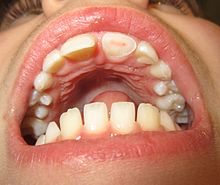
A broken upper forepart tooth showing the pink of the pulp
Molar abnormalities may be categorized according to whether they have environmental or developmental causes.[57] While environmental abnormalities may appear to accept an obvious cause, there may not announced to be any known cause for some developmental abnormalities. Environmental forces may bear upon teeth during development, destroy tooth structure after evolution, discolor teeth at whatsoever stage of development, or change the grade of tooth eruption. Developmental abnormalities most unremarkably bear upon the number, size, shape, and structure of teeth.
Environmental
Alteration during tooth development
Tooth abnormalities caused by environmental factors during tooth evolution have long-lasting effects. Enamel and dentin practise non regenerate later they mineralize initially. Enamel hypoplasia is a condition in which the amount of enamel formed is inadequate.[58] This results either in pits and grooves in areas of the tooth or in widespread absence of enamel. Lengthened opacities of enamel does non affect the amount of enamel simply changes its appearance. Affected enamel has a different translucency than the rest of the tooth. Demarcated opacities of enamel have sharp boundaries where the translucency decreases and manifest a white, foam, yellow, or dark-brown color. All these may be caused by nutritional factors,[59] an exanthematous affliction (chicken pox, congenital syphilis),[59] [lx] undiagnosed and untreated celiac disease,[61] [62] [63] hypocalcemia, dental fluorosis, birth injury, preterm nativity, infection or trauma from a deciduous tooth.[59] Dental fluorosis is a condition which results from ingesting excessive amounts of fluoride and leads to teeth which are spotted, yellow, brown, black or sometimes pitted. In nigh cases, the enamel defects caused past celiac disease, which may be the simply manifestation of this disease in the absence of any other symptoms or signs, are not recognized and mistakenly attributed to other causes, such as fluorosis.[61] Enamel hypoplasia resulting from syphilis is ofttimes referred to as Hutchinson's teeth, which is considered one role of Hutchinson's triad.[64] Turner'due south hypoplasia is a portion of missing or diminished enamel on a permanent tooth normally from a prior infection of a nearby primary molar. Hypoplasia may as well outcome from antineoplastic therapy.
Destruction after evolution
Tooth devastation from processes other than dental caries is considered a normal physiologic process but may become severe enough to get a pathologic status. Attrition is the loss of tooth construction past mechanical forces from opposing teeth.[65] Attrition initially affects the enamel and, if unchecked, may go on to the underlying dentin. Chafe is the loss of tooth structure by mechanical forces from a foreign element.[66] If this forcefulness begins at the cementoenamel junction, then progression of tooth loss tin can be rapid since enamel is very sparse in this region of the tooth. A common source of this blazon of molar article of clothing is excessive force when using a toothbrush. Erosion is the loss of molar structure due to chemic dissolution by acids not of bacterial origin.[67] Signs of tooth destruction from erosion is a common characteristic in the mouths of people with bulimia since vomiting results in exposure of the teeth to gastric acids. Some other important source of erosive acids are from frequent sucking of lemon juice. Abfraction is the loss of tooth structure from flexural forces. Every bit teeth flex under pressure, the arrangement of teeth touching each other, known as occlusion, causes tension on one side of the tooth and compression on the other side of the tooth. This is believed to crusade V-shaped depressions on the side nether tension and C-shaped depressions on the side nether pinch. When tooth destruction occurs at the roots of teeth, the procedure is referred to as internal resorption, when acquired by cells within the lurid, or external resorption, when caused by cells in the periodontal ligament.
Discoloration

Discoloration of teeth may result from bacteria stains, tobacco, tea, java, foods with an abundance of chlorophyll, restorative materials, and medications.[68] Stains from bacteria may crusade colors varying from green to black to orange. Green stains also outcome from foods with chlorophyll or excessive exposure to copper or nickel. Amalgam, a common dental restorative material, may plough adjacent areas of teeth black or greyness. Long term use of chlorhexidine, a mouthwash, may encourage extrinsic stain formation near the gingiva on teeth. This is usually easy for a hygienist to remove. Systemic disorders as well can cause molar discoloration. Congenital erythropoietic porphyria causes porphyrins to be deposited in teeth, causing a red-dark-brown coloration. Blue discoloration may occur with alkaptonuria and rarely with Parkinson's affliction. Erythroblastosis fetalis and biliary atresia are diseases which may cause teeth to appear green from the deposition of biliverdin. As well, trauma may change a molar to a pinkish, yellow, or dark grayness colour. Pinkish and red discolorations are also associated in patients with lepromatous leprosy. Some medications, such as tetracycline antibiotics, may get incorporated into the construction of a tooth, causing intrinsic staining of the teeth.
Alteration of eruption
Tooth eruption may exist altered by some environmental factors. When eruption is prematurely stopped, the tooth is said to be impacted. The most common cause of molar impaction is lack of space in the mouth for the molar.[69] Other causes may be tumors, cysts, trauma, and thickened bone or soft tissue. Tooth ankylosis occurs when the tooth has already erupted into the mouth merely the cementum or dentin has fused with the alveolar bone. This may cause a person to retain their primary tooth instead of having it replaced past a permanent one.
A technique for altering the natural progression of eruption is employed by orthodontists who wish to delay or speed up the eruption of sure teeth for reasons of space maintenance or otherwise preventing crowding and/or spacing. If a master molar is extracted before its succeeding permanent tooth's root reaches ⅓ of its full growth, the eruption of the permanent tooth will be delayed. Conversely, if the roots of the permanent molar are more than ⅔ complete, the eruption of the permanent tooth will be accelerated. Between ⅓ and ⅔, it is unknown exactly what will occur to the speed of eruption.
Developmental
Abnormality in number
- Anodontia is the total lack of tooth development.
- Hyperdontia is the presence of a higher-than-normal number of teeth.
- Hypodontia is the lack of evolution of one or more teeth.
- Oligodontia may be used to depict the absence of 6 or more than teeth.
Some systemic disorders which may result in hyperdontia include Apert syndrome, cleidocranial dysostosis, Crouzon syndrome, Ehlers–Danlos syndrome, Gardner's syndrome, and Sturge–Weber syndrome.[70] Some systemic disorders which may upshot in hypodontia include Crouzon syndrome, Ectodermal dysplasia, Ehlers–Danlos syndrome, and Gorlin syndrome.[71]
Abnormality in size
- Microdontia is a condition where teeth are smaller than the usual size.
- Macrodontia is where teeth are larger than the usual size.
Microdontia of a unmarried tooth is more than probable to occur in a maxillary lateral incisor. The second most likely tooth to take microdontia are third molars. Macrodontia of all the teeth is known to occur in pituitary gigantism and pineal hyperplasia. It may besides occur on one side of the face in cases of hemifacial hyperplasia.
Abnormality in shape

The fusion of two deciduous teeth
- Gemination occurs when a developing tooth incompletely splits into the formation of two teeth.
- Fusion is the union of 2 side by side teeth during development.
- Concrescence is the fusion of two divide teeth only in their cementum.
- Accompaniment cusps are additional cusps on a tooth and may manifest as a Talon cusp, Cusp of Carabelli, or Dens evaginatus.
- Dens invaginatus, too chosen Dens in dente, is a deep invagination in a tooth causing the advent of a tooth within a molar.
- Ectopic enamel is enamel found in an unusual location, such as the root of a tooth.
- Taurodontism is a status where the torso of the tooth and pulp chamber is enlarged, and is associated with Klinefelter syndrome, Tricho-dento-osseous syndrome, Triple X syndrome, and XYY syndrome.[72]
- Hypercementosis is excessive germination of cementum, which may event from trauma, inflammation, acromegaly, rheumatic fever, and Paget's disease of bone.[72]
- A dilaceration is a bend in the root which may have been caused by trauma to the molar during formation.
- Supernumerary roots is the presence of a greater number of roots on a tooth than expected
Crack lip and palate and their association with dental anomalies
At that place are many types of dental anomalies seen in crack lip and palate (CLP) patients. Both sets of dentition may be affected; however, they are ordinarily seen in the affected side. Most ofttimes, missing teeth, supernumerary or discoloured teeth can be seen; notwithstanding, enamel dysplasia, discolouration and delayed root development are also mutual. In children with cleft lip and palate, the lateral incisor in the alveolar cleft region has the highest prevalence of dental developmental disorders;[73] this status may exist a crusade of tooth crowding.[74] This is important to consider in order to correctly plan treatment keeping in mind considerations for office and aesthetics. By correctly analogous direction invasive treatment procedures tin exist prevented resulting in successful and bourgeois handling.
In that location have been a plethora of research studies to calculate prevalence of certain dental anomalies in CLP populations notwithstanding a multifariousness of results have been obtained.
In a report evaluating dental anomalies in Brazilian cleft patients, male patients had a higher incidence of CLP, agenesis, and supernumerary teeth than did female patients. In cases of complete CLP, the left maxillary lateral incisor was the near commonly absent molar. Supernumerary teeth were typically located distal to the cleft.[75] In a written report of Jordanian subjects, the prevalence of dental anomaly was higher in CLP patients than in normal subjects. Missing teeth were observed in 66.vii% of patients, with maxillary lateral incisor every bit the well-nigh oftentimes affected tooth. Supernumerary teeth were observed in 16.7% of patients; other findings included microdontia (37%), taurodontism (70.v%), transposition or ectopic teeth (30.viii%), dilacerations (19.2%), and hypoplasia (thirty.8%). The incidence of microdontia, dilaceration, and hypoplasia was significantly higher in bilateral CLP patients than in unilateral CLP patients, and none of the anomalies showed any significant sexual dimorphism.[76]
It is therefore evident that patients with cleft lip and palate may nowadays with a diverseness of dental anomalies. It is essential to assess the patient both clinically and radiographically in order to correctly care for and preclude progression of whatsoever dental problems. Information technology is also useful to notation that patients with a scissure lip and palate automatically score a five on the IOTN ( index for orthodontic need) and therefore are eligible for orthodontic treatment, liaising with an orthodontist is vital in order coordinate and program treatment successfully.
Aberration in construction
- Amelogenesis imperfecta is a condition in which enamel does not grade properly or at all.[77]
- Dentinogenesis imperfecta is a condition in which dentin does not course properly and is sometimes associated with osteogenesis imperfecta.[78]
- Dentin dysplasia is a disorder in which the roots and pulp of teeth may exist affected.
- Regional odontodysplasia is a disorder affecting enamel, dentin, and pulp and causes the teeth to appear "ghostly" on radiographs.[79]
- Diastema is a condition in which at that place is a gap betwixt two teeth caused past the imbalance in the relationship betwixt the jaw and the size of teeth.[fourscore]
See also
- Barodontalgia
- Dentistry
- Dental auxiliary
- Dental assistant
- Dental hygienist
- Dental technician
- Dental braces
- Dental notation
- Dental tourism
- Head and cervix anatomy
- Regenerative endodontics
- Socket preservation
- Natural language
- Tooth fairy
- Tooth painting
- Tooth regeneration
Lists
- List of basic dentistry topics
- Listing of oral wellness and dental topics
References
Notes
- ^ Clemente, Scarlet (1987). Anatomy, a regional atlas of the man torso. Baltimore: Urban & Schwarzenberg. ISBN978-0-8067-0323-7.
- ^ Ash 2003, p. half-dozen
- ^ Cate 1998, p. 3
- ^ Ash 2003, p. ix
- ^ "Impacted wisdom teeth". Mayo Clinic. Retrieved 5 March 2022.
- ^ Sorenti, Mark; Martinón‐Torres, María; Martín‐Francés, Laura; Perea‐Pérez, Bernardo (2019). "Sexual dimorphism of dental tissues in modern homo mandibular molars". American Journal of Concrete Anthropology. 169 (2): 332–340. doi:10.1002/ajpa.23822. ISSN 1096-8644. PMID 30866041.
- ^ Ross 2002, p. 441
- ^ Cate 1998, p. 1
- ^ a b Cate 1998, p. 219
- ^ "Tooth enamel | Drug Bigotry Database".
- ^ a b Johnson, Clarke (1998). "Biological science of the Human Dentition Archived 2015-ten-30 at the Wayback Auto". uic.edu.
- ^ Cate 1998, p. 198
- ^ "Astringent Plane-Form Enamel Hypoplasia in a Dentition from Roman Britain". ResearchGate . Retrieved 2019-01-09 .
- ^ a b c Ross 2002, p. 448
- ^ a b c Cate 1998, p. 150
- ^ Ross 2002, p. 450
- ^ Cate 1998, p. 152
- ^ Zilberman, U.; Smith, P. (2001). "Sexual activity- and Age-related Differences in Master and Secondary Dentin Formation". Advances in Dental Enquiry. 15: 42–45. CiteSeerX10.1.1.535.5123. doi:10.1177/08959374010150011101. PMID 12640738. S2CID 4798656.
- ^ "Tertiary Dentine Frequencies in Extant Not bad Apes and Fossil Hominins". ResearchGate . Retrieved 2019-03-28 .
- ^ Cate 1998, p. 236
- ^ Cate 1998, p. 241
- ^ Ross 2002, p. 451
- ^ Walton, Richard Eastward. and Mahmoud Torabinejad. Principles and Practice of Endodontics. 3rd ed. 2002. pp. 11–xiii. ISBN 0-7216-9160-nine.
- ^ Cate 1998, p. 95
- ^ a b Cate 1998, p. 81
- ^ a b c Lab Exercises: Molar development. University of Texas Medical Branch.
- ^ Cate 1998, pp. 86 and 102.
- ^ a b c d Ross 2002, p. 453
- ^ Kranich, Ernst-Michael (1990) "Anthropologie", in F. Bohnsack and E-M Kranich (eds.), Erziehungswissenschaft und Waldorfpädagogik, Reihe Pädagogik Beltz, Weinheim, p. 126, citing Frances Ilg and Louise Bates Ames (Gesell Institute), School Readiness, p. 236 ff
- ^ Silvestro, JR (1977). "Second Dentition and School Readiness". New York State Dental Journal. 43 (iii): 155–8. PMID 264640.
...the loss of the get-go deciduous tooth can serve as a definite indicator of a male child'due south readiness for reading and schoolwork
- ^ a b Ross 2002, p. 452
- ^ Cate 1998, p. 256
- ^ Cate 1998, p. 260
- ^ Listgarten, Max A. "Histology of the Periodontium: Master fibers of the periodontal ligament," University of Pennsylvania and Temple University. Created May 8, 1999, revised 16 January 2007.
- ^ Cate 1998, p. 270
- ^ Cate 1998, p. 274
- ^ Cate 1998, pp. 247 and 248
- ^ Cate 1998, p. 280
- ^ "Oral Health Topics: Plaque", American Dental Association.
- ^ Introduction to dental plaque Archived 2011-08-27 at the Wayback Car, Leeds Dental Establish.
- ^ Ophardt, Charles E. "Sugar and tooth disuse", Elmhurst College.
- ^ Dental Cavities, MedlinePlus Medical Encyclopedia.
- ^ Seiler R, Spielman AI, Zink A, Rühli F (2013). "Oral pathologies of the Neolithic Iceman, c.three,300 BC". European Journal of Oral Sciences (Historical Article. Inquiry Support, Non-U.South. Gov't). 121 (3 Pt i): 137–41. doi:x.1111/eos.12037. PMID 23659234.
- ^ Suddick RP, Harris NO (1990). "Historical perspectives of oral biological science: a series". Crit. Rev. Oral Biol. Med. 1 (ii): 135–51. doi:10.1177/10454411900010020301. PMID 2129621.
- ^ Healthy People: 2010. Healthy People.gov.
- ^ "Dental caries", from the Disease Control Priorities Projection.
- ^ Touger-Decker R, van Loveren C (2003). "Sugars and dental caries". Am. J. Clin. Nutr. 78 (4): 881S–892S. doi:ten.1093/ajcn/78.4.881S. PMID 14522753.
- ^ Hardie JM (1982). "The microbiology of dental caries". Dent Update. 9 (4): 199–200, 202–four, 206–viii. PMID 6959931.
- ^ Moore WJ; Moore, Due west.J. (1983). "The role of saccharide in the aetiology of dental caries. i. Sugar and the antiquity of dental caries". J Dent. eleven (3): 189–90. doi:ten.1016/0300-5712(83)90182-iii. PMID 6358295.
- ^ a b Oral Health Topics: Cleaning your teeth and gums. American Dental Association.
- ^ Introduction to Dental Plaque Archived 2011-08-27 at the Wayback Car. Leeds Dental Institute.
- ^ Thumbs down for electric toothbrush, BBC News, Jan 21, 2003.
- ^ Cate 1998, p. 223
- ^ "Oral Health Topics: Dental Filling Options". ada.org.
- ^ "Prosthodontic Procedures", The American College of Prosthodontists.
- ^ "Dental Implants", American Association of Oral and Maxillofacial Surgeons.
- ^ Neville 2002, p. l.
- ^ Ash 2003, p. 31
- ^ a b c Kanchan T, Machado M, Rao A, Krishan M, Garg AK (Apr 2015). "Enamel hypoplasia and its role in identification of individuals: A review of literature". Indian J Dent (Revisión). 6 (2): 99–102. doi:x.4103/0975-962X.155887. PMC4455163. PMID 26097340.
- ^ Neville 2002, p. 51
- ^ a b Dental Enamel Defects and Celiac Disease Archived 2016-03-05 at the Wayback Machine National Institute of Health (NIH)
- ^ Ferraz EG, Campos Ede J, Sarmento VA, Silva LR (2012). "The oral manifestations of celiac disease: information for the pediatric dentist". Pediatr Paring (Review). 34 (7): 485–viii. PMID 23265166.
- ^ Giuca MR, Cei Thou, Gigli F, Gandini P (2010). "Oral signs in the diagnosis of celiac disease: review of the literature". Minerva Stomatol (Review). 59 (ane–2): 33–43. PMID 20212408.
- ^ Syphilis: Complications, Mayo Clinic.
- ^ "Loss of Molar Structure", American Dental Hygiene Association.
- ^ "Abnormalities of Teeth", University of Missouri-Kansas Metropolis School of Dentistry.
- ^ Yip, KH; Smales, RJ; Kaidonis, JA (2003). "The diagnosis and control of extrinsic acid erosion of molar substance" (PDF). General Dentistry. 51 (4): 350–3, quiz 354. PMID 15055615. Archived from the original (PDF) on September 7, 2006.
- ^ Neville 2002, p. 63
- ^ Neville 2002, p. 66
- ^ Neville 2002, p. 70
- ^ Neville 2002, p. 69
- ^ a b Neville 2002, p. 85
- ^ Tortora C, Meazzini MC, Garattini Yard, Brusati R (March 2008). "Prevalence of abnormalities in dental structure, position and eruption pattern in population of unilateral and bilateral fissure lip and palate patients". The Cleft Palate-Craniofacial Journal. 45 (2): 154–162. doi:10.1597/06-218.i. PMID 18333651. S2CID 23991279.
- ^ "Dental Crowding: Causes and Treatment Options". Orthodontics Australia. 2020-06-29. Retrieved 2021-02-06 .
- ^ Luciane Macedo de Menezes; Susana Maria Deon Rizzatto; Fabiane Azeredo; Diogo Antunes Vargas (2010). "Characteristics and distribution of dental anomalies in a Brazilian cleft population". Revista Odonto Ciência. 25 (2): 137–141. doi:10.1590/S1980-65232010000200006.
- ^ Al Jamal GA, Hazza'a AM, Rawashdeh MA (2010). "Prevalence of dental anomalies in a population of cleft lip and palate patients". The Cleft Palate-Craniofacial Journal. 47 (4): 413–420. doi:10.1597/08-275.one. PMID 20590463. S2CID 7220626.
- ^ Amelogenesis imperfecta, Genetics Home Reference, a service of the U.S. National Library of Medicine.
- ^ Dentinogenesis imperfecta, Genetics Home Reference, a service of the U.South. National Library of Medicine.
- ^ Cho, Shiu-yin (2006). "Conservative Management of Regional Odontodysplasia: Example Report" (PDF). J Can Dent Assoc. 72 (8): 735–8. PMID 17049109.
- ^ ASDC Journal of Dentistry for Children, Volume 48. American Gild of Dentistry for Children, 1980. p. 266
Sources
- Ash, Major M.; Nelson, Stanley J. (2003). Wheeler's Dental Anatomy, Physiology, and Occlusion (eighth ed.). ISBN978-0-7216-9382-8.
- Cate, A. R. Ten (1998). Oral Histology: development, structure, and function (fifth ed.). Mosby. ISBN978-0815129523.
- Neville, B. W.; Damm, D.; Allen, C.; Bouquot, J. (2002). Oral & Maxillofacial Pathology (2nd ed.). W.B. Saunders. ISBN978-0-7216-9003-2.
- Ross, Michael H.; Kaye, Gordon I.; Pawlina, Wojciech (2002). Histology: a Text and Atlas (fourth ed.). Baltimore: Lippincott Williams & Wilkins. ISBN978-0683302424.
External links
 | Look up tooth in Wiktionary, the free dictionary. |
- An commodity on the use of man molar used every bit a neolithic pendant
- Molar eruption nautical chart
When Do Babies Get More Than 4 Teeth
Source: https://en.wikipedia.org/wiki/Human_tooth
0 Response to "When Do Babies Get More Than 4 Teeth"
Post a Comment